
What It Costs to Own a Condo in Playa del Carmen
The Property Tax Will Surprise You in a Good Way. The Electricity Bill and the Empty Months Are What Actually Cost You.
by Blue Playa Rentals on September 20, 2026
Almost everything written about buying property here stops at the closing table. The notary, the permit, the trust, the transfer tax — plenty of guides cover that, including ours. What almost nobody writes down is the part that starts the day after: what the place costs you every year whether you set foot in it or not.
That gap is why owners get surprised in year two, not year one. And the surprises do not come where people expect them. The property tax here is genuinely cheap. The electricity bill can be brutal. And the single most expensive thing you can do with a condo in this climate is leave it closed up and assume nothing is happening inside it.
Here is the honest breakdown, line by line.
Property Tax: The Cheap Surprise
If you are coming from the United States or Canada, the predial is going to look like a rounding error. Mexican property tax is calculated on the cadastral value, which is the value the municipality has on record — and that figure sits well below what you actually paid. The result is an annual bill that, for most condos here, lands in the hundreds of dollars, not the thousands.
Playa del Carmen also pays you to pay early. The municipality published its 2026 schedule in January: 25 percent off if you settled the full year between 1 and 15 January, 15 percent for the rest of January, and 10 percent through the end of February. Owners over 60, pensioners and people with disabilities get 50 percent off on one residential property, and that window ran to 30 June.
Two things to keep in mind before you file this under solved. The discounts only apply if you pay the whole year up front, so the owner who pays in June pays full price. And cadastral values get revised. A low bill today is not a promise about 2030.
Electricity: The One That Bites
This is where owners lose money without understanding why, so it is worth being precise about the mechanism.
Quintana Roo sits on a subsidised residential tariff built for hot climates, with a consumption allowance that is generous in summer and much tighter the rest of the year. Stay under it and electricity here is cheap. Go over it, consistently, and CFE reclassifies the meter into the high-consumption tariff known as DAC.
Under DAC you do not pay a penalty. You lose the subsidy entirely. The rate per kilowatt-hour jumps several times over, a fixed monthly charge appears, and the bill stops resembling the one you were getting. The reclassification is based on your rolling consumption average, which means one hot month will not do it — but a pattern will, and getting back out requires sustained months under the limit, not a single quiet one.
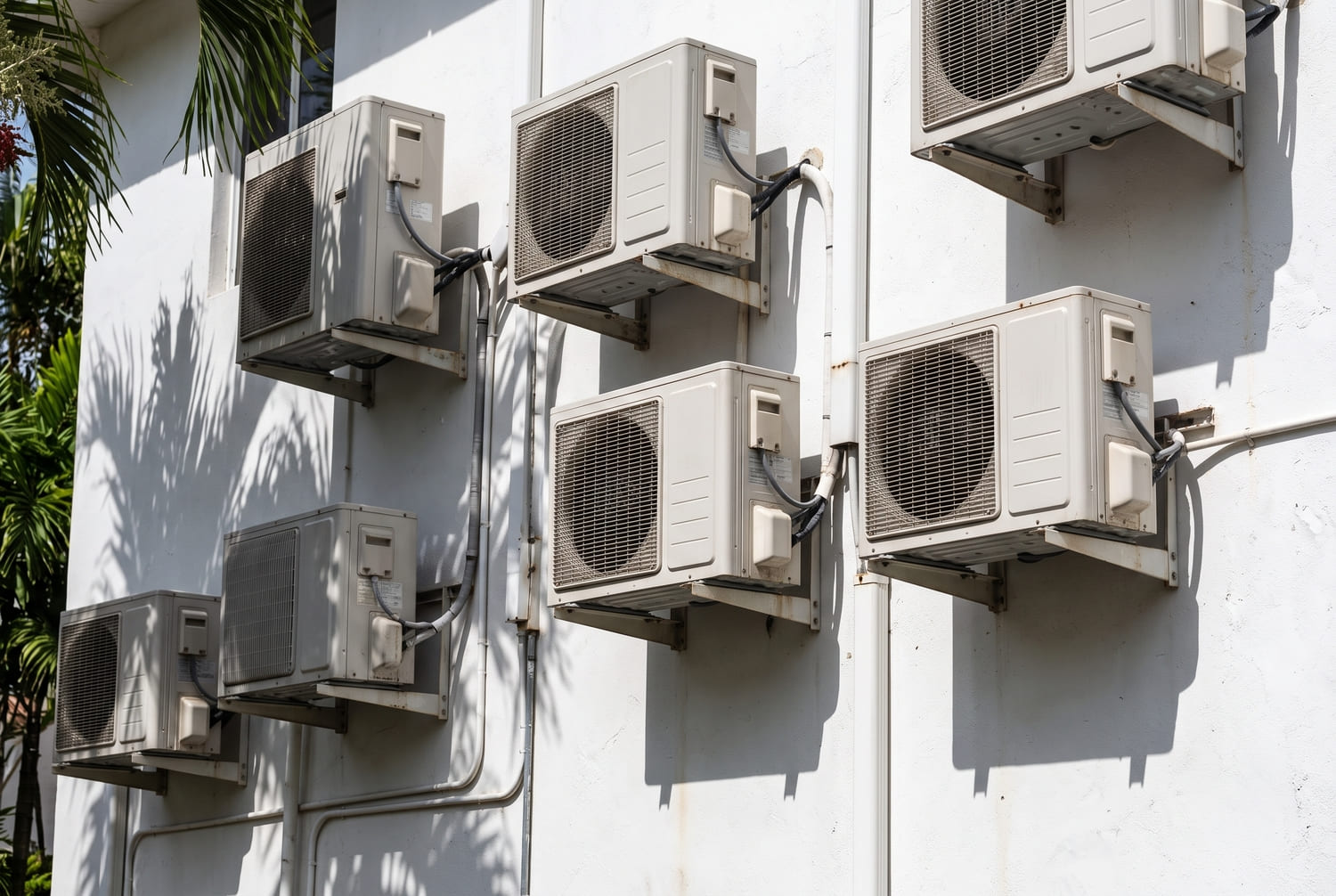
Now the part specific to a second home: air conditioning is what pushes a unit into DAC, and it does not need you to be there. Plenty of owners leave the A/C running in an empty unit to keep the humidity down. It works, and it is also the fastest way to buy a DAC classification you will be living with for the better part of a year.
If you want to understand the climate you are managing against, our month-by-month breakdown of Playa del Carmen weather shows where the humidity and the heat actually sit.
Water: Small, Until There Is a Leak
Water in Playa del Carmen is billed by Aguakan, the concessionaire, at tariffs set by the state Congress and published monthly. The bill is a base charge plus a rate on consumption above it, with sewerage, sanitation and VAT added on top.
For a condo in normal use this is the smallest line on this page. The reason it is on the page at all is the structure: because you pay a rate on everything above the base, a running toilet or a slow leak in an empty unit does not show up as an inconvenience. It shows up as a bill, two months later, after the water has been running the whole time.
Not ready to put it on the rental market yet? A long-term tenant is the simplest way to stop a unit sitting empty. Our long-term rentals in Playa del Carmen page shows what the market here looks like by neighbourhood and what tenants expect from a furnished unit.
The Maintenance Fee Nobody Mentions in the Brochure
For most condos here, the cuota de mantenimiento is the largest recurring cost of ownership — larger than the property tax, often larger than the utilities. It pays for the pool, the security staff, the landscaping, the elevators, the common-area electricity and the building's administration.
It is also the line with the widest spread, because it has nothing to do with your unit and everything to do with your building. A small walk-up with a plunge pool and a part-time gardener is a different number from a tower with 24-hour security, two elevators and a rooftop pool.
What to ask for, and when
The last twelve months of the building's actual accounts, not the quoted monthly fee. The fee tells you what is budgeted; the accounts tell you what was spent.
Whether there are special assessments pending. Elevators, roof waterproofing and pool equipment do not fail politely, and in a building with no reserve fund that cost arrives as a one-time call on every owner.
What percentage of units are current on their fees. In a building where half the owners are behind, the ones who pay end up covering the shortfall.
Ask before you buy, when the seller still needs something from you. After closing, you are just another owner asking the administration for paperwork.
The Fideicomiso Does Not End at Closing
If you bought as a foreigner within the restricted zone — which includes all of this coast — your title sits in a bank trust. Setting it up is a one-time cost that every buying guide covers, including our own guide to buying a condo in Playa del Carmen.
What gets budgeted less often is the annual fee. The bank holding the trust charges every year, for the life of the trust, and the amount is set by that bank rather than by any public schedule — so it varies, and it is worth asking what yours is before you sign rather than discovering it on a statement. It is not a large number next to the maintenance fee. It is simply one more thing that arrives whether you visited or not.
The Real Cost: The Months Nobody Is In It
Add up everything above and you get a number most owners can live with. The line that does not appear on any of those bills is what the climate does to a closed unit.
Heat and humidity here do not pause when you fly home. In a unit that sits shut for months, the things that go wrong are predictable and they are all cheaper to catch early: damp in soft furnishings, mould in the places air does not move, appliance seals and rubber components giving out, batteries dying in anything that has them, and the slow plumbing problem that nobody is there to notice.
None of that is dramatic on its own. The cost is in the timing. A leak found in week one is a plumber. The same leak found in month four is a floor, a ceiling for the neighbour below, and a conversation with the building's administration.
This is the arithmetic that moves owners from leaving a unit empty to putting it in someone's hands, and it is usually not about rental income. It is about the fact that somebody is in the unit regularly.
If your unit is sitting empty between visits, that is the expensive option. We manage properties here with our own cleaning and maintenance teams rather than subcontractors, which means somebody is actually in your unit on a schedule. See how our property management works, or get in touch and tell us about your building.
The Short Version
Split the costs by whether they care about your travel plans:
Arrives no matter what: property tax, maintenance fee, the annual trust fee, the water base charge, and the deterioration of an unoccupied unit.
Scales with use: electricity, water above the base, and wear from actual guests — which is the cheapest kind of wear, because somebody is there to report it.
The second list is the one owners worry about. The first list is the one that costs them.
If you are still deciding whether this is somewhere you want to own at all rather than visit, what it is actually like to live in Playa del Carmen is the more useful question to answer first.


