
Sargassum Season Is Closing in Playa del Carmen
We Collected More Than Any Other Municipality in Quintana Roo This Year — 42,063 Tons — and the Beaches Are Clear Right Now. Both Things Are True.
on September 22, 2026
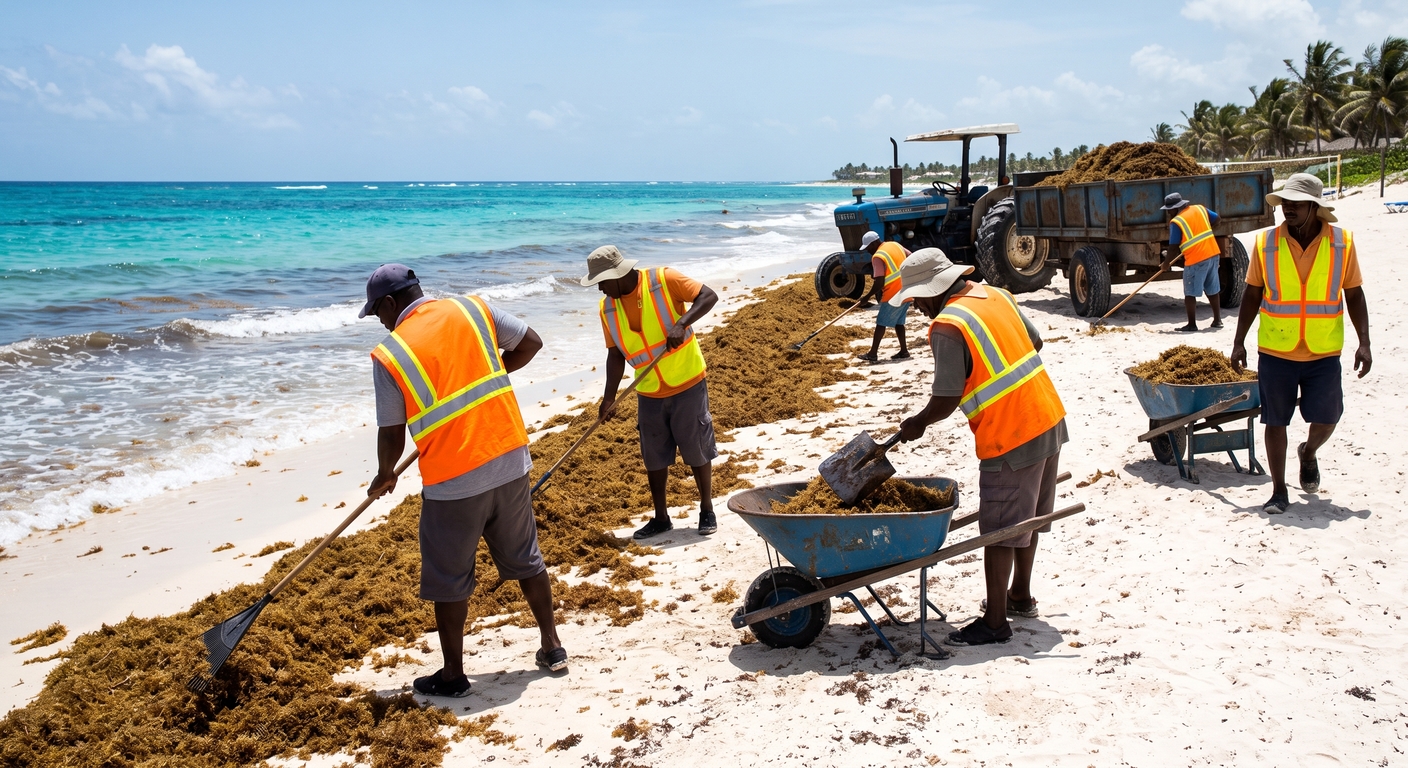
Start with the number nobody in the tourism business wants to lead with. Between April and August, Quintana Roo's Secretariat of Ecology and Environment collected 124,852 tons of sargassum across the state's coastal municipalities. Playa del Carmen accounted for 42,063 of them — more than Cancún, more than Tulum, more than any other municipality on the coast. Roughly a third of the state's total landed on our stretch of sand.
That is about 29,000 tons more than the same period last year, statewide. It was, as forecast back in the spring, the heaviest season on record.
Now the part that matters if you are planning a trip: the season is closing, and as of this month the beaches here are clear.
What Changed in the Last Three Weeks
On 27 August, the Mexican Navy lowered its sargassum alert for Quintana Roo from red to yellow, citing a clear decline in arrivals compared with the critical window in May and June. It was the first downgrade of the season.
On 1 September, the director of Playa del Carmen's federal maritime zone office said the city had recorded only minimal arrival over the previous ten days, and that he expected September, October and November to stay essentially clear. His words were blunt: from here on, if anything lands, it will be the bare minimum.
That tracks with the pattern we described in our August report on the season, and with what we see every year managing properties here. The heavy window runs roughly May through August. From November through April, the beaches are consistently clear.
Why Our Number Was the Biggest
It is worth being precise about this, because a headline figure invites the wrong conclusion. Playa del Carmen did not collect the most sargassum because it is the worst beach on the coast. Two things drive that number.
Geography. Our beaches face east onto the open Caribbean with no island or offshore reef barrier to break up incoming rafts, unlike Cozumel, which collected 1,375 tons all season, or Isla Mujeres with 3,877.
Effort. Playa del Carmen runs one of the most aggressive collection operations on the coast, with crews working daily through the peak. A big collection figure reflects both what arrives and how much of it gets hauled away.
A beach that collects nothing is not necessarily a clean beach. It can also be a beach nobody is cleaning.
A Note on the Numbers Themselves
If you have been following the reporting this year, you will have seen different figures for the same thing, and it is worth knowing why. The state environment secretariat, the Navy and the municipal federal-zone office each count different things: what municipal crews haul off the sand, what vessels intercept at sea, what is removed from the federal zone in one municipality. They are not contradicting each other. They are measuring separate parts of the same operation.
So treat any single tonnage figure as one agency's slice, not the whole. The figures in this post are the state secretariat's April-to-August count, published on 12 September.
What This Means for the Next Six Months
High season here runs from December through April, and it overlaps almost exactly with the months the beaches are reliably clear. If you are booking for the winter, sargassum is not the thing to plan around — weather and crowds matter far more.
There is a second thing worth saying, and it cuts against the usual seasonal pitch. Right now, in the shoulder weeks between the end of the sargassum season and the start of high season, Playa del Carmen is quiet. The Riviera Maya hotel association reported occupancy at 64 percent in early September, and smaller hotels in town were running at 30 to 35 percent, with rates down sharply. Local operators expect that to hold through October before December turns it around.
Which means October and November are the cheapest weeks of the year to be here, with clean beaches and no crowds. That is not a marketing line; it is what the occupancy numbers say.
The Honest Caveat
A downgraded alert is not a guarantee. Sargassum arrives in rafts that move with the wind, and conditions swing week to week and beach to beach — northerly and easterly winds push it away, westerlies bring it in. Last year the official season closed on 31 October and cleanup still ran into the middle of November.
So if you are coming in the next few weeks, check a live beach map the morning you plan your day rather than trusting any forecast, including ours. The Sargassum Monitoring Network tracks individual beaches along this coast and updates from community and official reports. We explain how to read it, and what the season looks like month by month, in our full guide to seaweed in Playa del Carmen.
This was the heaviest season the state has recorded. It is also, right now, over. Both of those are worth saying out loud.


